
Braces
Do braces hurt?
What do you feel when brackets are fitted and in the first days, and how can you ease it?
2 min read Dr. Kemal Bulut Çırpan · 2 November 2026 · 6 min read
Many families think of orthodontics as something to consider “once all the baby teeth have fallen out and the adult teeth are in”. In fact, the growth of the jaws and the order in which teeth come through give important clues much earlier. The American Association of Orthodontists (AAO) recommends that every child has a first orthodontic check-up by around age 7.
By this age the first permanent molars and front incisors have started to come through. This makes it possible to assess how the teeth and jaws relate to each other, in other words the bite. Because the jawbones are still growing, some problems can be guided more easily by making use of this growth.
This does not mean every child will start treatment at 7. For most children, monitoring at regular intervals is enough. The aim is not to miss the right moment if treatment is needed.
If you notice any of the following, you can see an orthodontist even before age 7:
Having one of these signs does not necessarily mean there is a problem. But having an orthodontist take a look will give you peace of mind.
The first examination is a short, painless visit. Your child’s mouth and face are examined, and we look at how the teeth are coming through, the bite and any habits. Photographs and X-rays are taken if needed. The examination usually ends with one of these three outcomes:
Early (phase 1) treatment is considered in situations such as crossbite, bite problems where the lower jaw is forward, severe crowding, open bite caused by habits, or upper front teeth that stick out and are vulnerable to knocks.
The aim at this stage is to guide jaw development in the right direction, make room for the permanent teeth and reduce the need for more complex treatment later. Early treatment is often short. A second phase of treatment may be needed once the permanent teeth are complete.
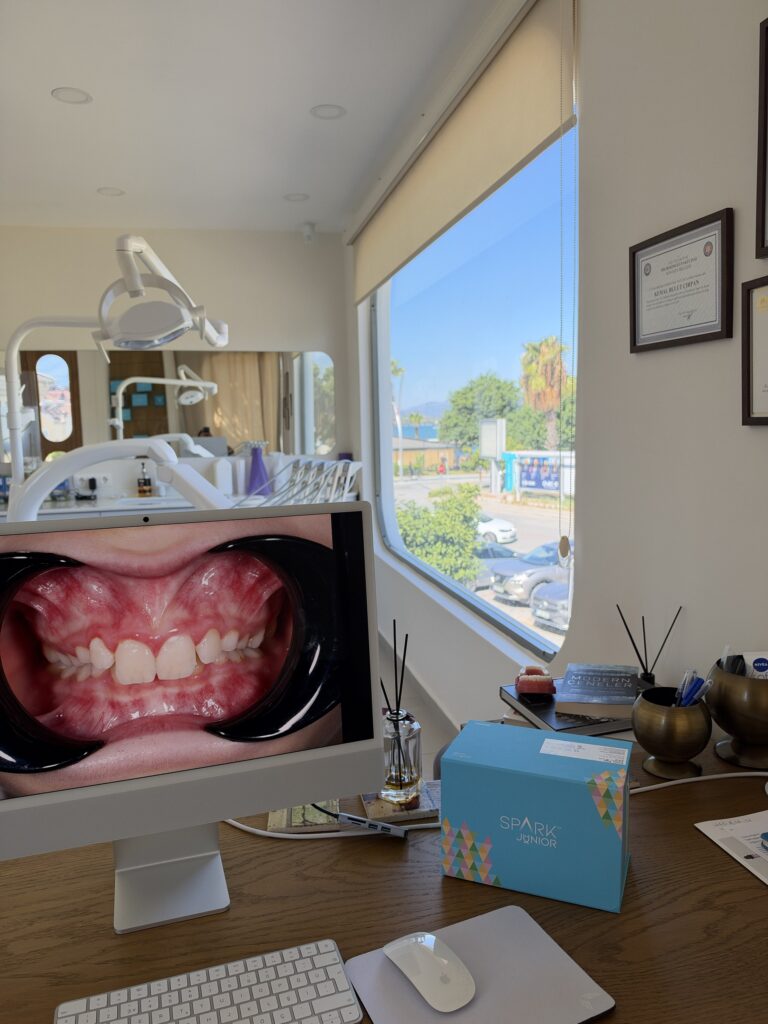
Invisalign First and Spark Junior are clear aligner systems developed for the mixed dentition stage, when baby teeth and permanent teeth are present together. Because they are removable, brushing is easy, and they are barely noticeable at school. We offer both systems at our clinic.
Clear aligners are not suitable for every child. In some cases fixed or removable appliances are the better choice. Which one is right is decided together after the examination and records.
For more information about children’s orthodontics, see our OrthoKids: Children’s Orthodontics page.
Do you have a question about your child’s teeth? Book an OrthoKids examination.
Book an AppointmentDr. Kemal Bulut Çırpan, DDS
Orthodontist in Fethiye. PhD in orthodontics, Invisalign and Spark provider.
© 2026 Fethiye Ortodonti. Tüm hakları saklıdır.
by Bilgin Graph
